
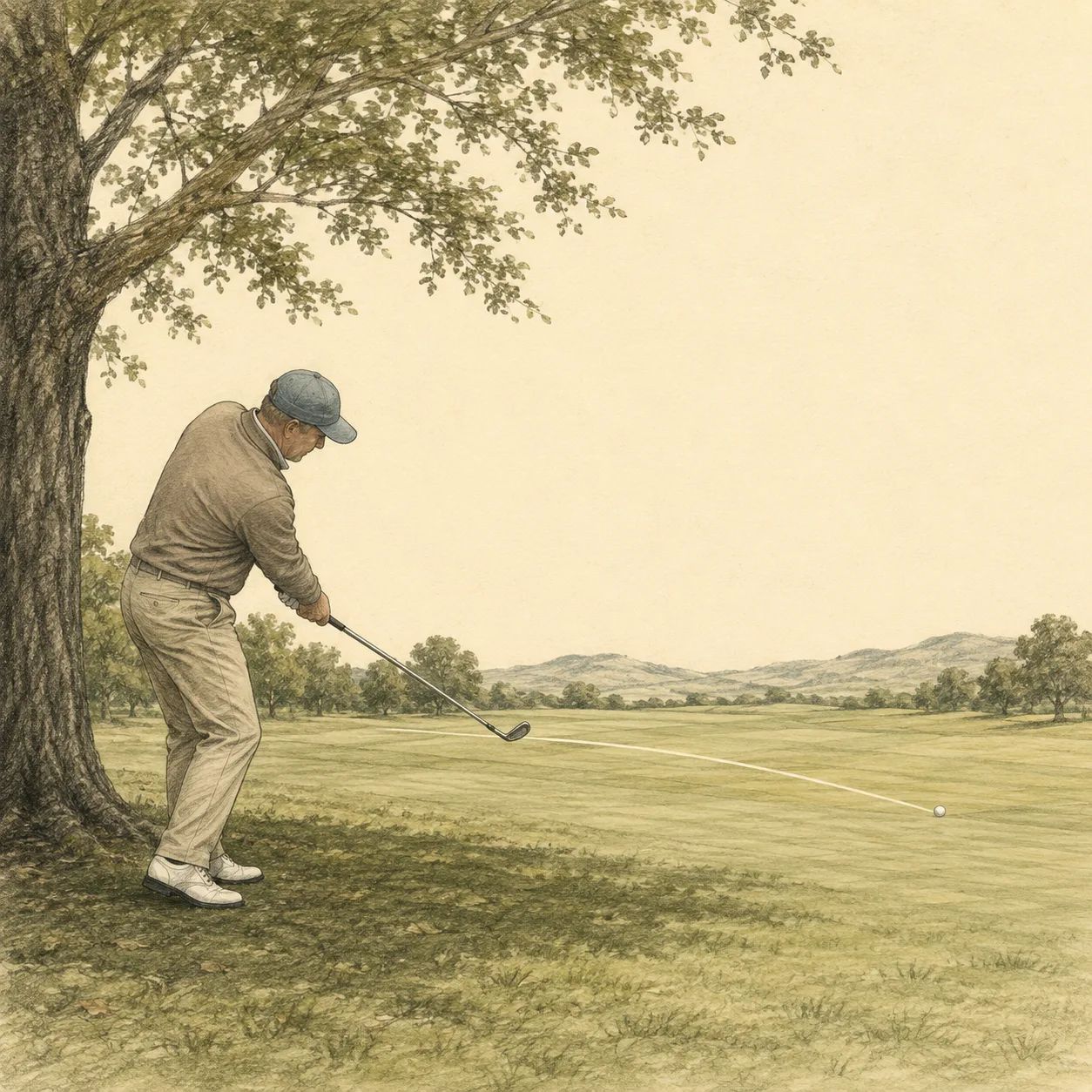
Your drive finishes beneath a tree. The fairway is visible, the ball is sitting reasonably well, and the flag is still 150 yards away. You accept that you need to play out. Then you try to get most of those 150 yards back with the recovery shot.
The ball catches a branch. You are now playing another recovery, from a worse position.
Choosing to escape is only half the decision. You also need a shot you can execute and somewhere sensible for it to stop. A useful punch-out gets you from an obstructed lie to an ordinary next shot. For an amateur with limited practice time, that is a skill worth owning.
Define the next shot before choosing the escape
Start by finding a broad area from which you could make your normal swing toward the green. Look beyond the first opening between the trees: where will the ball finish after it lands and rolls?
Three things need to fit:
- A playable lie: enough access to the ball and room for the swing you intend to make.
- A generous exit: room for your usual start-direction and height errors.
- A useful stopping area: open ground that leaves an unobstructed next shot.
An opening that points toward the hole can fail the third test. You might clear the nearest tree and finish behind the next one. A sideways route may leave you farther from the flag but able to play a straightforward approach.
Neither direction is automatically correct. Compare the actual options. If a forward opening is wide, the lie is clean, and your practiced shot fits, use it. If getting forward requires threading a narrow gap or inventing a curve, the sideways option deserves a serious look.
Distance control matters after the ball clears the branches
Consider this practice example: you need roughly 20 yards of carry to clear the rough, with another 15 yards of fairway available before the far edge. A shot that carries 30 yards and keeps running can clear the trees perfectly and still leave you in trouble.
Those distances describe an example, not a recommended club or swing length. Your club, strike, landing slope, and ground firmness determine what happens. The useful habit is to think about both the first landing point and the final stopping area.
Inspect the ground between them. A low runner needs a usable route along the turf. Thick grass, an upslope, or a bunker across that route can make a different exit more practical. On firm ground, leave room beyond your intended landing point.
Judge the recovery by the next shot it gives you. Clearing a branch is an intermediate result.
Choose the club you have tested
The idea behind this article comes from the GolfRealist book notes: a plain, low hybrid recovery beneath trees has practical value that a beautiful range shot may never deliver. The important word is functional. The hybrid is an option to test, not a requirement.
Compare it with a mid-iron you already strike comfortably. One may be easier to start on line; the other may be easier to stop in your chosen area. A club that works from short grass may be less useful when grass sits behind the ball. Let the results decide which one becomes your default.
For a basic low iron shot, PGA coach Brendon Elliott recommends modest setup changes: the ball slightly behind center, a little more pressure on the lead side, a narrower stance, and gripping down slightly. Pair that with a shorter, smoother swing and a balanced, abbreviated finish. His guide to a lower ball flight provides the technical starting point.
Practice those adjustments in an open area. Avoid turning “keep it low” into an extreme ball position or a hard chopping motion. If you cannot produce a manageable flight, ask a coach to help you establish one simple version.
Build a 15-minute punch-out practice session
Use a permitted practice area with room to see the ball land and stop. Represent the trees with an imaginary flight ceiling and a broad exit corridor. You do not need to fire balls at real trunks or place rigid obstacles in their path.
The session below is a GolfRealist practice proposal. Its timings and scoring are organizational choices, not a validated training prescription.
First five minutes: learn the flight and rollout
Choose one club, one clean lie, and a generous finish area. Make several short, controlled swings. Watch the initial height, first bounce, and final position. Count an overhit runner as a miss even if it stays low.
Try a second club only if you need a comparison. Keep the question narrow: which club lets you produce this modest escape most comfortably? You are collecting a usable distance range, not searching for your longest punch shot.
Next five minutes: change one condition
Keep the club and change the required distance. Then, if the facility allows it, try a similar task from light rough. Notice whether the previous shot still works. Adjust the target or choose another club when the lie demands it.
This applies one idea from The Constraints-Led Golf Practice Guide to a specific recovery problem. Here, success requires both an exit and a controlled finish; simply producing a low flight is insufficient.
Final five minutes: take five separate attempts
Before each ball, choose an exit corridor and a stopping area. Step away between attempts. Vary the target so you have to make a fresh decision.
Award one point only when the ball meets all three conditions: it stays within your intended flight window, clears the imagined obstruction, and stops in the playable area. Give each situation one attempt. If you repeat a miss to learn from it afterward, keep the original test result.
Record the score and the main failure: too high, wrong direction, too short, or too long. The broader Golf Practice Scorecard explains how to track outcomes without letting the best shot rewrite the session.
Know when your punch-out does not fit
A useful recovery shot has limits. Roots, stones, restricted footing, or a blocked swing can remove an option before you consider distance. Do not force a stroke through a hard obstruction. Choose another route or consider the relief options that apply to your situation.
Height is another limit. If you have only practiced under a generous imaginary ceiling, you have little evidence for a shot beneath a much lower branch. Give your actual pattern room. The same principle applies to a narrow opening: being able to see through it does not establish that you can reliably hit through it.
Finally, notice the urge to compensate for the drive. Making the recovery longer cannot erase the previous stroke. If frustration is changing your choice, use the reset described in Stop Trying to Fix Every Bad Golf Shot: acknowledge the result, assess the new position, and choose the next target.
Take one reliable escape to the course
After a few sessions, you should be able to describe your option plainly: the club, the lies it works from, its usual height, and roughly how far it carries and runs. Keep testing those limits as conditions change.
You do not need a collection of spectacular recovery shots. Start with one modest escape you have practiced and know when to use. When a drive finds the trees, getting back to an ordinary golf shot is a worthwhile result.
Editorial basis: GolfRealist book-development notes on the low hybrid recovery and practicing unfamiliar shots. The scenarios and 15-minute session above are proposed exercises, not reported playing results.