
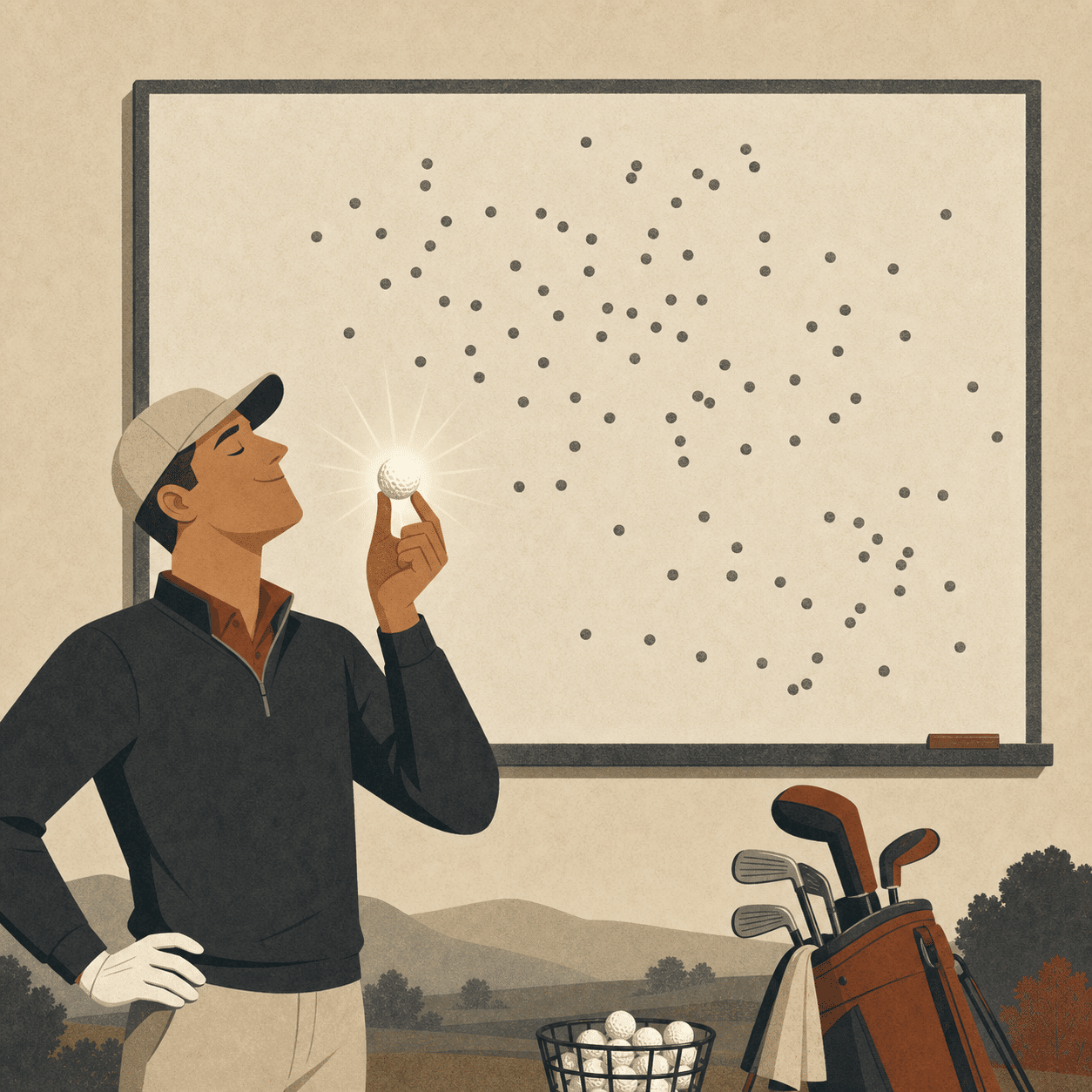
“How did you practise?”
“Pretty well. I hit some really good ones.”
This is not a measurement. It is a memory bias.
Golfers remember the flushed iron and the final straight drive. They forget the first fifteen balls, the left miss that appeared seven times and the fact that every good shot used the same club from the same lie.
If practice has no score, the ego becomes the statistician.
What should practice measure?
A useful practice scorecard tracks four things:
Outcome: Did the ball finish in the acceptable area?
Pattern: Where did misses cluster?
Decision: Was the chosen target and club sensible?
Transfer: Could the skill survive one attempt, a changed club or a new lie?
This is not a perfect scientific model. It is more honest than counting “good feelings.”
The 20-shot scorecard
Use twenty shots and divide them into four blocks.
Block 1: Calibration — five shots
Use the same club and a broad target. Record start direction, curve and contact. Do not make a major change yet.
Block 2: Variability — five shots
Change target or distance every ball. Award one point when the ball finishes inside the defined area.
Block 3: Decision — five scenarios
Create a situation before each shot: protected flag, trouble on one side, uncertain carry, awkward lie or wind. Award one point for the sensible decision before judging execution.
Block 4: Transfer — five one-ball shots
Use the complete routine. Change club and target. No replacement balls. Award one point for completing the intended task.
You now have an outcome score out of ten across the final two execution blocks, plus a decision score out of five and a visible miss pattern.
Define success before hitting
A target cannot be invented after the shot.
“Near the flag” is too vague. Use a fairway corridor, a green sector, a landing circle or a start-line gate. The acceptable area should reflect your skill and the shot’s difficulty.
A 20-handicap player should not use PGA Tour proximity as a passing grade. The point is to make decisions around your pattern, not borrow someone else’s.
Track trends, not daily verdicts
One score can be affected by fatigue, weather and random variation. Repeat the test weekly under reasonably similar conditions.
Look for trends:
- Is the average improving?
- Is one miss becoming dominant?
- Are decisions better even when execution varies?
- Does performance collapse in the transfer block?
- Are you practising at an appropriate challenge level?
A low score is useful if it identifies the next problem.
Do not game your own test
The moment a golfer records a score, he becomes creative.
Targets grow larger. Borderline balls become successes. Difficult scenarios disappear.
Write the rules before the first shot. If you change the test, label it as a new version.
The number is not the goal
A scorecard should guide practice, not become another source of mechanical panic. It measures a sample, not your identity.
The best outcome may be discovering that your strike is acceptable but your targets are reckless. Or that your block practice looks excellent while transfer remains poor.
Pretty shots produce dopamine.
Patterns produce decisions.
Keep the second one.
Source: Broadie, M. (2014), Every Shot Counts, for outcome-based golf performance measurement; practice scorecard is a GolfRealist application.