
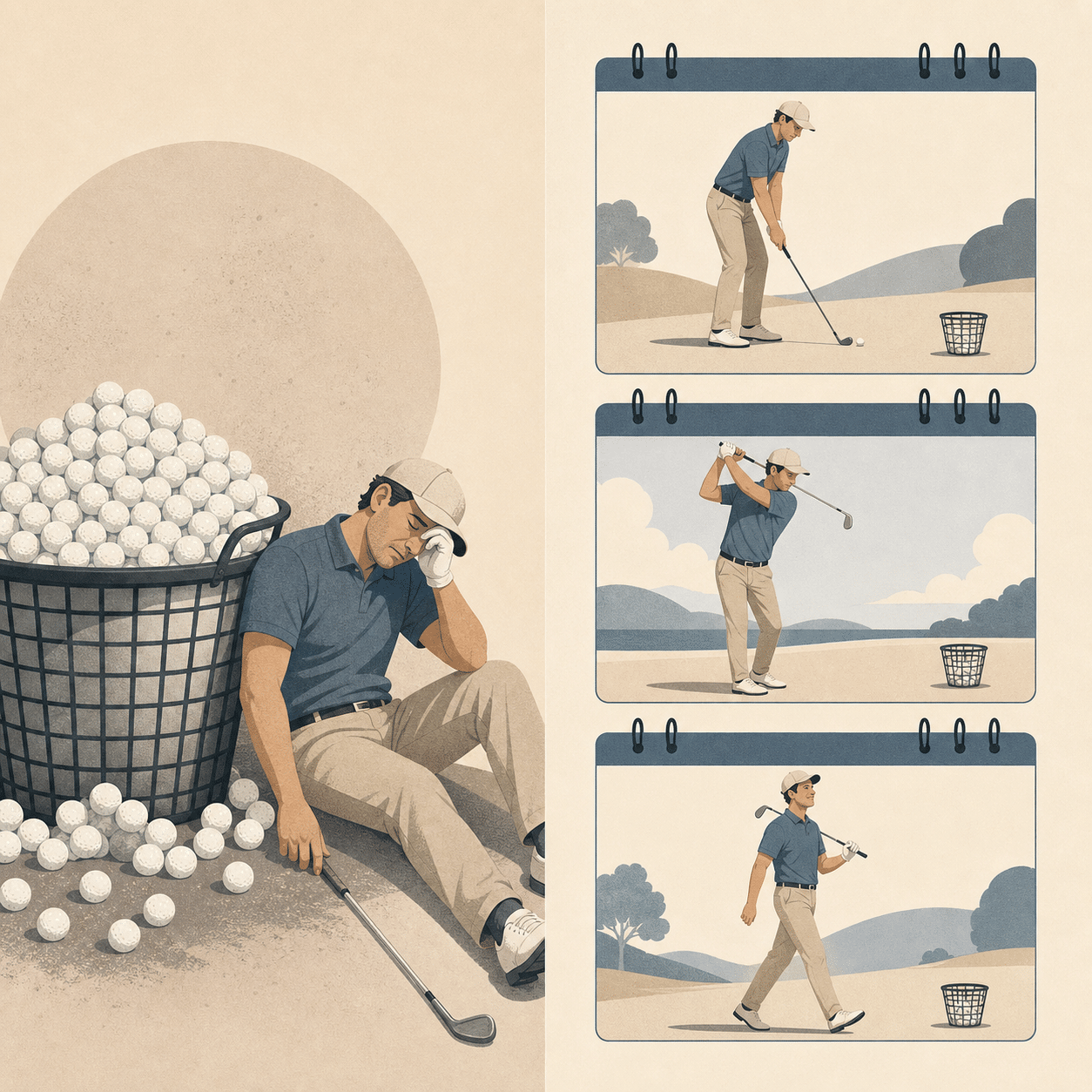
The weekly golf practice ritual is easy to recognise.
No practice from Monday to Saturday. Then a large bucket on Sunday. The first twenty balls find the swing. The next forty feel productive. The final twenty are hit by a tired golfer trying to preserve the good feeling created by ball number 63.
Then six days pass.
A long session is not worthless. But when the goal is learning rather than exercise, distributing the same time across several sessions is often the better bargain.
Repetition and learning are not the same thing
Massed practice creates continuity. The solution from the previous attempt is still available. You remember the feel, the correction and the target. Performance improves during the session.
That improvement can be real, but it can also be temporary.
Spacing forces retrieval. When you return a day or two later, you must reconstruct the solution. This feels less fluent, yet the act of retrieving and rebuilding is part of what makes learning more durable.
The uncomfortable restart is not wasted time. It is the test.
A realistic amateur schedule
Suppose you have 90 minutes per week.
Instead of one 90-minute bucket, try:
Session 1 — 30 minutes: contact and calibration
Warm up briefly. Work on one defined task. Finish with five changing targets.
Session 2 — 30 minutes: variability
Change club, distance and target after each ball. Include the lies or distances that caused trouble in your last round.
Session 3 — 30 minutes: performance
Use one ball. Create a nine-shot course or a short-game test. Record the score. No technical rescue bucket afterward.
The total time is identical. The learning opportunities are not.
Short sessions need sharper goals
A short session fails if ten minutes are spent deciding what to practise.
Arrive with one question:
- Can I start eight-foot putts across a gate?
- Can I land chips in three different zones?
- What is my actual carry pattern with two clubs?
- Can I hit nine changing targets with one pre-shot routine?
A specific task compresses practice. A vague intention expands to fill the bucket.
Stop while quality remains
Fatigue changes movement and attention. Sometimes training while tired is useful because golf itself involves fatigue. But mindlessly extending a technical session after coordination has deteriorated is not resilience training. It is often low-quality repetition.
Set an end point before you begin: a time limit, a number of balls or a completed game.
The last ball does not need to be perfect. Ending on a good shot is an emotional preference, not a law of motor learning.
What if you can only practise once?
Then create spacing inside the session.
Break the 90 minutes into different tasks. Leave the range for the putting green. Insert a short pause. Return to a skill after working on something else. Change clubs and targets so the previous solution is not automatically available.
You can also use five-minute home sessions for putting start line, setup or routine—provided the task is safe and measurable.
The GolfRealist version
Do not ask how many balls you hit this week.
Ask how many times you had to recall, adapt and solve.
One long session can make you feel as if you own the movement. Three shorter sessions are more likely to reveal whether you can find it again.
Golf does not reward the swing you discovered after fifty consecutive balls.
It rewards the swing you can produce cold.
Source: Lee, T. D. & Genovese, E. D. (1988), “Distribution of practice in motor skill acquisition: Learning and performance effects reconsidered.”