
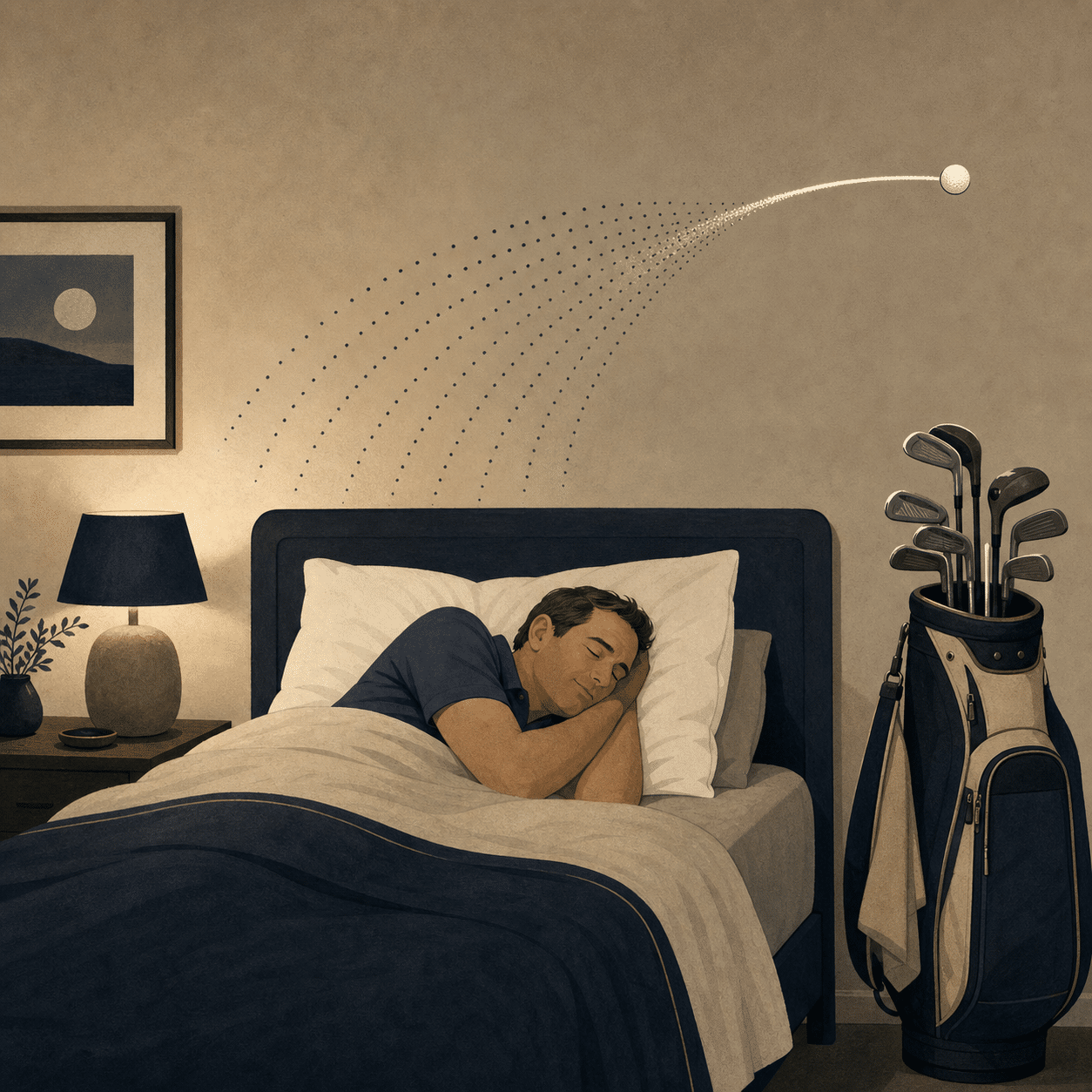
Golfers believe practice ends when the bucket is empty.
Your nervous system has not received that memo.
After practice, the memory of a movement can continue to stabilise and change. Sleep is associated with the consolidation of many forms of memory, including motor skills. That does not mean one nap will add ten yards to your drive. It means the performance you see during a session is not the final verdict on what was learned.
This matters because golfers are impatient judges.
The dangerous final-ball test
Imagine you work on a small change. The session feels awkward. Contact varies. You leave without the satisfying sequence of pure shots that normally signals success.
The next day, the task feels clearer.
The opposite can also happen. You stripe the final ten balls after a long block, return two days later and cannot reproduce them.
The first session looked worse but may have created useful adaptation. The second looked better but relied on temporary calibration.
Immediate performance and durable learning are different measurements.
What sleep can—and cannot—do
Sleep supports biological processes involved in memory consolidation. Research in motor learning suggests that offline periods can help stabilise or enhance certain skills, although the size and nature of the benefit depend on the task, training design and sleep conditions.
The honest conclusion is not “sleep fixes your swing.”
It is this: poor sleep is a strange foundation for someone who claims to care about learning, and the value of a practice session should not be judged solely by how it ended.
Practical consequences for golfers
Do not panic after one awkward session.
Give a clearly defined change time to settle. Test it again before adding three new corrections.
Keep late technical sessions simple.
If you practise in the evening, finish with a clear task rather than a frustrated search through multiple swing ideas.
Retest before you reteach yourself.
Start the next session with a small transfer test: different target, one attempt, normal routine. See what survived.
Track sleep alongside performance.
For two weeks, record sleep duration, perceived sleep quality and a simple practice score. You are not conducting a clinical trial. You are looking for a personal pattern.
Protect sleep before competition.
A perfect eight-hour prescription is unrealistic for many players, and tournament nerves exist. But alcohol, late screens, travel and an early tee time are still variables worth managing.
The bigger lesson
Golf culture celebrates visible effort: large buckets, long sessions, sore hands.
Recovery is invisible, so it looks like inactivity.
But learning is not measured by how tired you become. A 35-minute session with a precise task, followed by recovery and a later retest, may teach more than two hours of angry repetition.
The serious golfer is not the one who always hits more balls.
It is the one who gives useful practice a chance to become stable.
Your swing does not stop learning when you leave the range.
Make sure the rest of your life is not teaching it exhaustion.
Source: Walker, M. P. et al. (2002), “Practice with sleep makes perfect: Sleep-dependent motor skill learning,” Neuron.