
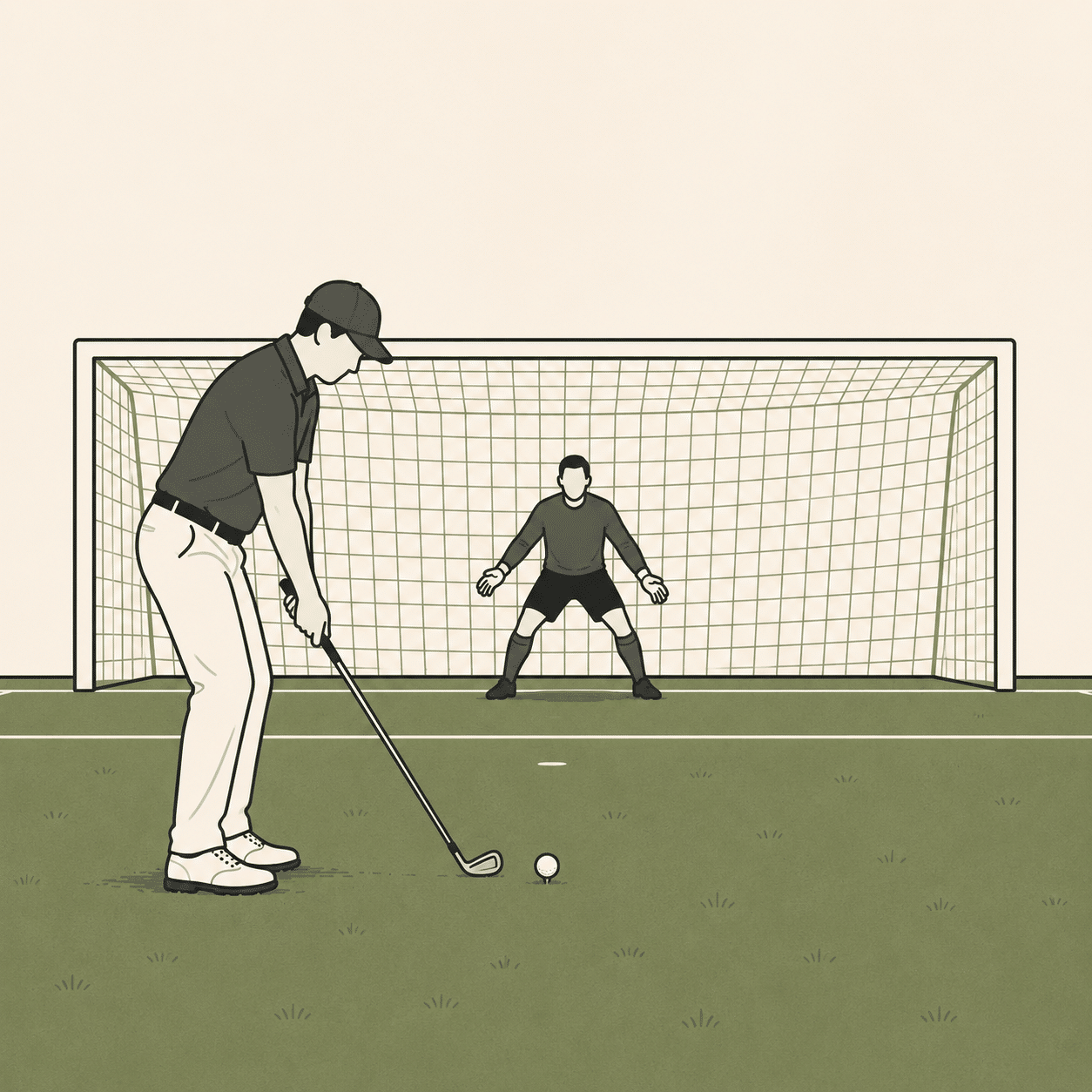
Frank had already picked his line. Draw around the tree, land it on the down-slope, let it feed toward the pin. Good plan. Then, halfway through his downswing, he remembered the water on the right, decided the tree was actually closer than he thought, and tried to steer the club face open at the last possible instant.
The result traveled roughly forty degrees left of where either of his two plans pointed, hit a cart path, and disappeared into a hedge that, as far as anyone knew, had never previously been in play.
“You had a shot,” Steve said, not looking up from his phone. “Then you had a different shot. You hit neither of them.”
“I read something new,” Frank said.
“You read panic,” Steve said. “That’s not the same as information.”
A shootout, a missed penalty, and a familiar problem
The night before, both men had watched Switzerland beat Colombia on penalties at the World Cup — a 4-3 shootout that only got there after 120 goalless minutes. Manuel Akanji, a seasoned international defender who has now missed decisive penalties in three different tournaments, sent his effort well over the bar. On the Colombian side, two players hit the ball firmly enough that it cannoned off the crossbar and out.
None of these were technique failures in the way club golfers imagine technique failure. These are elite athletes with well-grooved motor patterns. What went wrong lives further upstream, in the decision itself — and it turns out sports scientists have spent two decades measuring exactly this.
What the research actually says
Penalty takers split into two broad strategies. Roughly three out of four professional shooters use what researchers call a “keeper-dependent” approach: they pick a side in advance, but stay ready to redirect the shot based on which way the goalkeeper moves. The remaining group commits to a spot before the run-up even starts and does not deviate, regardless of what the goalkeeper does.
Both strategies work. What doesn’t work is drifting between them mid-execution — deciding late, changing the plan, or trying to read new information after the motor sequence has already begun. Analysis of shootouts at World Cups and European Championships found that shooters using the keeper-dependent strategy carry a real cost: a meaningfully higher risk of running out of time to execute the redirected shot cleanly, because the body simply cannot process a new target and change trajectory as fast as the mind can change its intent.
Timing data makes the same point from a different angle. Bundesliga penalty analysis found that players who strike the ball in less than 200 milliseconds after the referee’s whistle — essentially reacting on impulse — convert at only 57%. Players who pause for at least a full second before committing convert at over 80%. The pause itself is not hesitation; it is the moment where the single decision gets locked in.
Even at the elite level, indecision has a visible price tag. Roughly a quarter of penalties in high-level competition either get saved or miss the target completely, and research separating “on target” from “off target” attempts shows a meaningful share of misses fly wide or high — not saved, just uncommitted, the ball going nowhere near where either plan intended.
The golf translation
Golf swings are penalty kicks with more time to panic in. A penalty taker has maybe a second between whistle and contact. A golfer has a full backswing, a transition, and a downswing — more than enough time to notice the water, remember the out-of-bounds stake, and quietly renegotiate the shot with themselves before impact.
The keeper-dependent penalty strategy has a legitimate golf equivalent: reading the lie, the wind, and the pin position, then picking a shot shape and target before you take the club back. That’s fine. What Frank did was closer to trying to change strategies mid-kick — after the decision had already been converted into a motor program, he tried to overwrite it with a new one, and the body executed neither version competently.
The fix implied by the data is almost insultingly simple: decide once, take the one-second pause the 80%-conversion group takes, and let the committed swing run its full course even if the second-guessing is technically correct. A partially-committed correct read consistently loses to a fully-committed decent one.
Frank tries it on eighteen
To his credit, Frank applied this literally on the next tee. He picked his shot, waited a full second, and swung without deviation.
He still missed the fairway. But Steve conceded it was, for the first time all day, a shot he actually recognized.
“Frank made one decision and executed it badly. Progress.” — Steve
Sources: Frontiers in Psychology (2021), Body Pose Estimation Integrated With Notational Analysis (PMC, 2022), and Bundesliga penalty-kick timing analysis via InnerDrive (2024).