
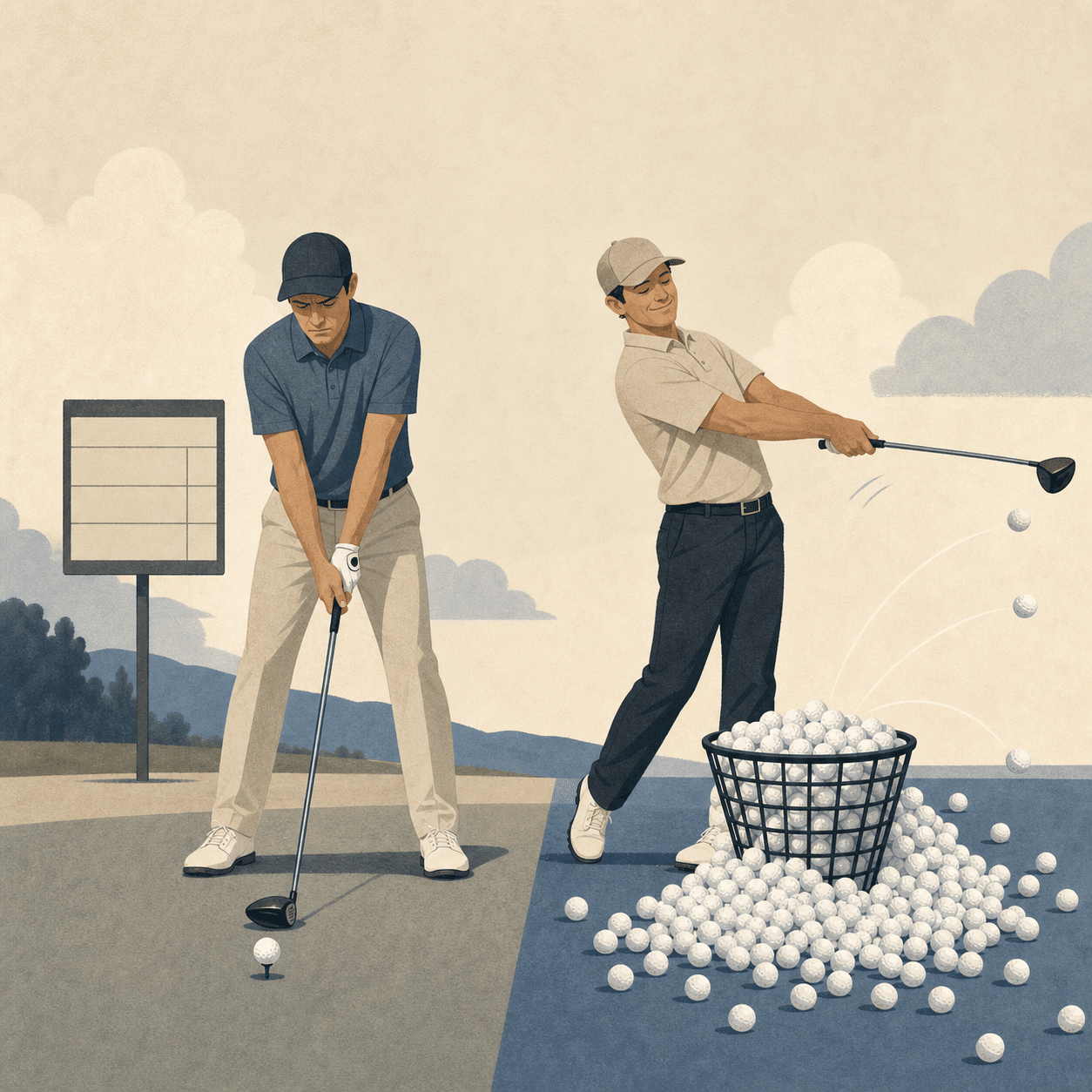
The range contains a remarkable number of clutch golfers.
They hit five-foot putts when missing changes nothing. They find fairways when another ball is already waiting. They produce beautiful wedges after the first three have calibrated the distance.
Then the Saturday medal arrives and the same shots feel different.
This is not mysterious. The golfer practised the movement but removed the consequence.
Pressure changes the task
Pressure is not only nervousness. It changes attention, decision-making, muscle tension and the meaning of the result. A shot that might affect your handicap, match or reputation is not experienced like ball 34 from a bucket.
You cannot reproduce tournament pressure perfectly in practice. You can make practice less emotionally sterile.
The key ingredients are:
- only one attempt
- a clear success condition
- a consequence for failure
- a recorded result
- uncertainty about the next task
Without these, “pressure practice” is usually ordinary practice with dramatic language.
Start with one-ball rules
Take one ball to the short-game area. Choose a realistic chip and putt it out. Record the score. Move to a new lie.
On the range, play a simulated nine holes. Choose fairway and green targets. Change club after every shot. A wild drive changes the next task; it does not earn an immediate replacement.
The aim is not realism down to the last blade of grass. It is to remove the automatic correction ball.
Add consequences carefully
A consequence should create attention, not fear.
Useful examples:
- If you miss the final three-foot putt, restart the drill.
- The loser buys coffee.
- A failed wedge test adds a small fitness task.
- You must post the weekly score to a practice partner.
- Beat your previous result before ending the game.
Money can create “skin in the game,” but it is not required. Reputation, time and a visible score can be enough.
Keep the stakes modest. The purpose is to practise coping, not to make practice miserable.
Use a pressure ladder
Level 1: score only
Complete a task and write down the result.
Level 2: limited attempts
You have one or three attempts, not an endless bucket.
Level 3: consequence
Failure triggers a restart or small agreed cost.
Level 4: social evaluation
Perform in front of a coach, friend or group.
Level 5: competitive simulation
Use unfamiliar tasks, a leaderboard and meaningful rewards or consequences.
Do not jump immediately to Level 5. Pressure training should itself be progressive.
Practise the response, not just the shot
The valuable moment may come after the miss.
Can you slow down? Can you accept the result? Can you make the next decision without technical panic? Can you use the same routine?
Pressure training that measures only the first result misses half the lesson. Golf is often the skill of producing a reasonable next action after an unreasonable outcome.
The limitation
Artificial pressure is still artificial. A restart penalty cannot fully reproduce the first tee of a club championship.
But a golfer who has never practised one-shot consequences should not be surprised when consequences feel foreign.
Do not wait for competition to discover your pressure response.
Train it at a volume you can handle, then gradually turn it up.
Source: Low, W. R., Freeman, P. & Butt, J. (2021), systematic review of pressure training interventions in sport.