
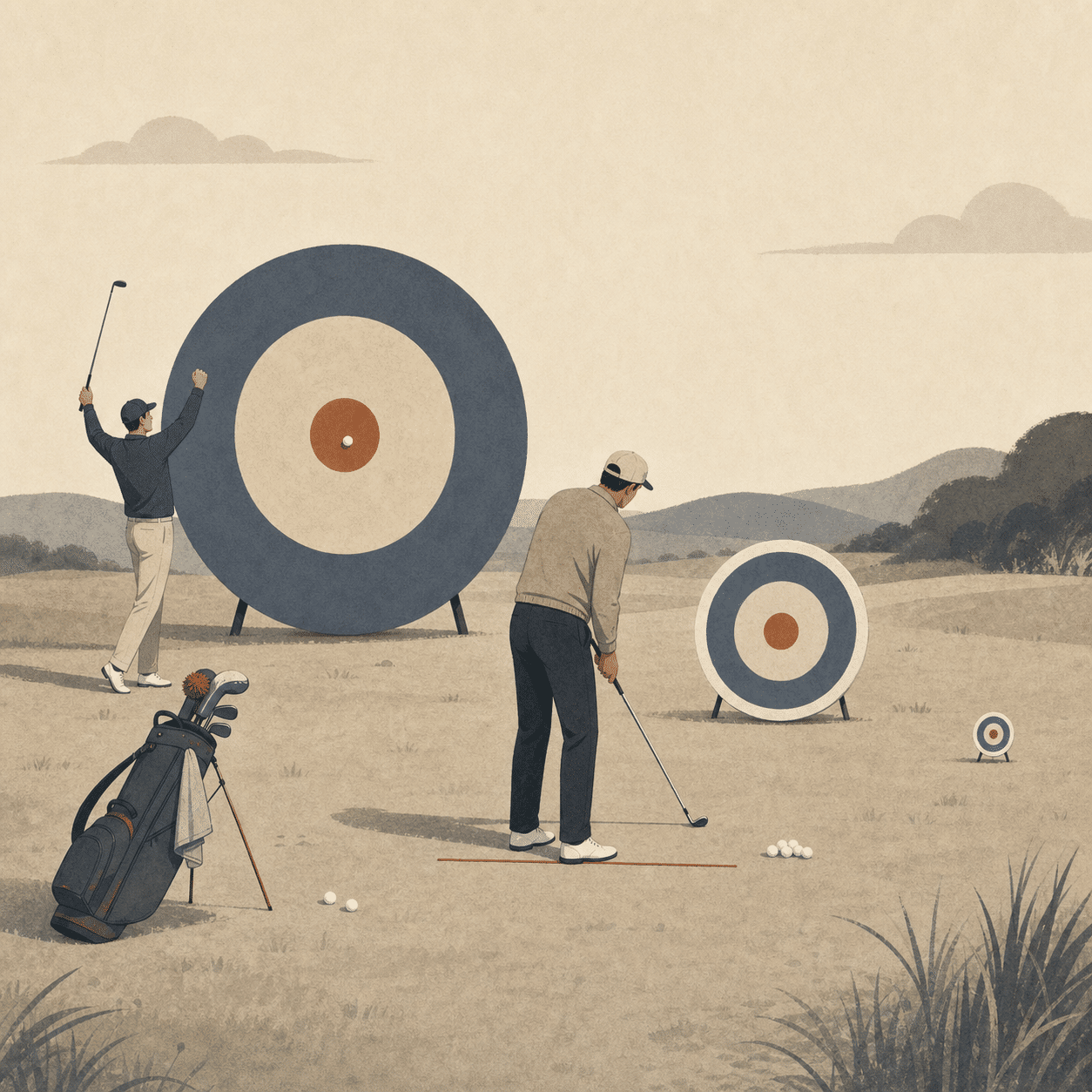
Good practice should be difficult.
That sentence has caused a lot of bad practice.
Some golfers interpret difficulty as punishment. They choose tiny targets, impossible lies and games they cannot complete. Every shot becomes failure, which must mean learning is happening.
Others protect themselves from failure. They hit their favourite club from a perfect mat to a generous target, repeating the same comfortable shot until the final five balls look excellent.
One practice is chaos without information. The other is performance without transfer.
Useful difficulty lives between them.
The challenge must match the player
The Challenge Point Framework proposes that learning depends on the relationship between the task, the environment and the learner’s skill level.
A task can be difficult in an objective sense—a 180-yard carry over water—but its useful learning value depends on who is attempting it. The same drill can bore a low-handicap player and overwhelm a beginner.
The goal is not maximum difficulty. It is the amount of difficulty that provides useful information while still allowing the player to search for solutions.
Signs that practice is too easy
- You use the same club and target for long stretches.
- The lie never changes.
- There is no consequence for missing.
- You know the result before you begin.
- Success exceeds roughly eight or nine shots out of ten.
- You finish feeling confident but learn little about your real pattern.
Easy practice has a place when introducing a movement or warming up. It becomes a problem when it is mistaken for proof of readiness.
Signs that practice is too hard
- Misses are so large that you cannot identify a pattern.
- You change technique after almost every ball.
- The task requires a shot you would never choose on the course.
- Fatigue destroys your normal movement.
- You cannot explain what the drill is teaching.
- Failure becomes random rather than informative.
Struggle is not automatically learning. Noise is still noise.
Adjust one variable at a time
You can make a task harder by changing:
- target size
- distance
- lie
- club
- time available
- shot shape
- consequence
- order of shots
- number of attempts
Do not increase all of them at once.
If you can land eight of ten chips inside a large zone, shrink the zone. If you can do that from a fairway lie, move two balls into light rough. If you can do it with unlimited attempts, make each ball count.
The task should stay understandable as it becomes more representative.
Build a three-level session
Create three versions of the same skill.
Green level: large target, familiar lie, moderate distance. You should succeed often.
Amber level: smaller target, mixed lies or changing distances. Success should require attention and adaptation.
Red level: one attempt, score attached, realistic consequence. This tests transfer and decision-making.
Move between the levels. If Red produces pure randomness, return to Amber. If Green becomes automatic, stop polishing it.
Measure the pattern
Do not judge the session by the best ball. Record the percentage of shots that complete the task and the shape of the misses.
The correct challenge often feels less satisfying than easy block practice. That is because it removes the illusion of competence.
Practice should not make you look good.
It should make tomorrow’s problem slightly easier to solve.
Source: Guadagnoli, M. A. & Lee, T. D. (2004), “Challenge Point: A Framework for Conceptualizing the Effects of Various Practice Conditions in Motor Learning.”