
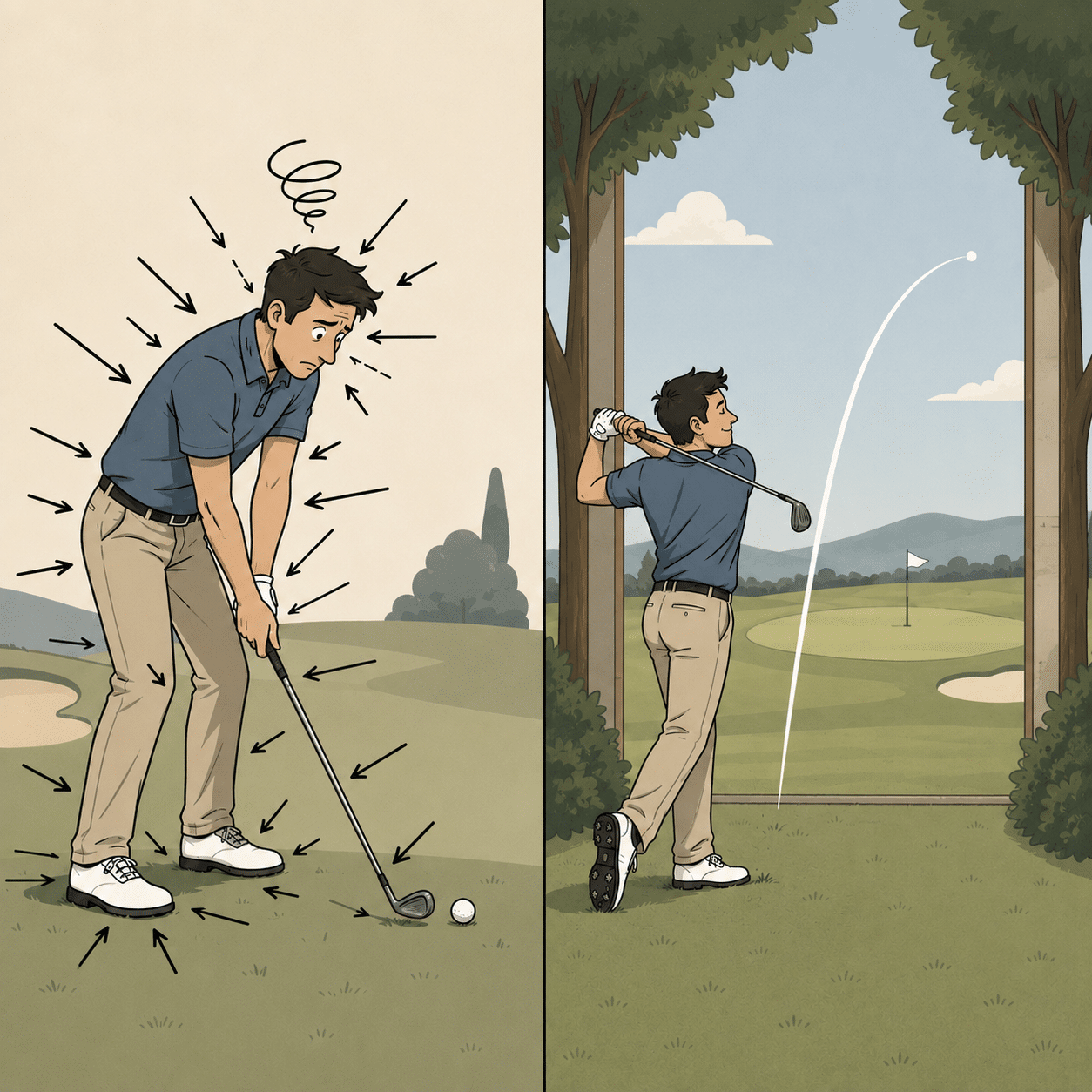
Ask a golfer what he is trying to do and you may receive an anatomy lesson.
Turn the shoulders. Load the trail side. Keep the head behind the ball. Lead with the hips. Hold the angle.
Ask where he wants the ball to go and the answer is less precise.
This is backwards.
Golf is an outcome game. The club interacts with the ball, the ball starts on a line, travels through a window and finishes in an area. Your body matters, but consciously managing every body part is not the only—or necessarily the best—way to produce that outcome.
Internal and external focus
An internal focus directs attention toward the body: rotate the hips, keep the arm straight, shift your weight.
An external focus directs attention toward the effect of the movement: clip the tee, brush the grass, start the ball right of the tree, roll it over a spot.
Motor-learning research across many tasks has repeatedly found advantages for instructions that direct attention toward the movement’s effect rather than the movement itself. The proposed explanation is simple: an external focus allows the motor system to organise coordination with less conscious interference.
This does not mean anatomy is fake or coaching is useless. It means the golfer does not always need to consciously control the mechanism to create the result.
Three useful levels of external focus
1. Contact
For a chip, focus on brushing a specific blade of grass beyond the ball. For a bunker shot, throw sand onto a chosen patch of green. For a putt, roll the ball across a mark.
2. Start direction
Choose a window a few metres in front of you. The task is to launch the ball through it. This is more useful than merely saying “do not go left.”
3. Landing and finish area
For wedges, define a landing zone. For approach shots, choose the safest finish area based on your dispersion. For putts, picture the speed at which the ball would reach the hole.
The farther the focus moves toward the actual golf problem, the more the practice begins to resemble playing.
An external-focus practice session
Hit five balls using one internal cue. Record the target result, not how the swing felt.
Then hit five balls with an external task that addresses the same problem. If contact is poor, use a brush point. If direction is poor, use a start window. If distance is poor, use a landing zone.
Finally, hit ten one-ball shots. Change club and target each time. Use the external task only. Score whether the ball completed the task.
This is not a laboratory experiment, but it is a more honest test than deciding that a swing “felt better.”
Do not turn the target into another technical command
Golfers are talented at corrupting simple ideas.
“Start it through the window” can become “change my wrist angle so the face is two degrees more open.” Now the external focus is gone and the committee has returned.
Let the task constrain the movement. Give your system a problem to solve and allow some variation in how it solves it.
The realistic limitation
An external focus will not repair every technical problem. Sometimes a physical limitation, equipment issue or significant movement pattern needs direct intervention from a qualified coach.
But technical work should eventually graduate into an external task. If a change only exists while you recite instructions on a flat mat, it has not yet become a golf skill.
Your scorecard does not ask how well you controlled your pelvis.
It asks where the ball finished.
Source: Wulf, G. (2013), “Attentional focus and motor learning: a review of 15 years,” International Review of Sport and Exercise Psychology.